Most people plan golf holidays the way they book birthdays—by dates, not by conditions. But once you’ve played long enough, or invested deeply enough in how time and performance intersect, you realize the calendar is a blunt instrument. The real leverage lives in climate, light, turf behavior, and demand asymmetry. This is where experienced golfers, travel designers, and operators stop buying trips and start structuring outcomes.
1. The Shoulder-Season Advantage: When Turf Outperforms the Tariff
Spain in March and April is often labeled a “value window,” but that framing undersells what’s actually happening on the ground. These weeks sit at a rare intersection of agronomy and atmosphere.
- Lower overnight humidity firms up fairways.
- Spring growth stabilizes greens without over-watering.
- Ball compression improves due to drier subsoil.
For your Golf Holidays, courses in Alicante or Murcia quietly deliver conditions closer to tournament prep than peak summer play. For serious golfers, this isn’t savings, it’s arbitrage. You’re accessing elite turf physics without paying for peak demand.
For dedicated operators, this window allows consistent service levels without seasonal strain, preserving course integrity while delivering measurable performance benefits to guests who know how to read between the lines.
2. The Latitudinal Hedge: Golf as Circadian Engineering
Advanced planners don’t think in hemispheres; they think in nervous systems. Pairing northern European winters with a Canary Islands or Andalucían escape isn’t indulgence, it’s biological risk management.
Consider the contrast:
- Long daylight rounds in the Costa Brava during June.
- A January reset in Tenerife or Gran Canaria, where African-latitude sun exposure recalibrates sleep and mood.
A ten-day stay at a place like Las Madrigueras or The Ritz-Carlton Abama isn’t just a golf trip—it’s an exploration of biophilic design while enjoying physiological arbitrage.
Ten days of golf in the Canaries provides a sustained “loading dose” of Vitamin D that is impossible to achieve in Northern Europe or the UK in winter. That makes cortisol patterns normalize and decision fatigue drop. For executives and high-functioning individuals, this kind of trip quietly restores capacity. For businesses designing premium travel, it signals a deeper understanding of wellness beyond spa menus.
3. Visual Geometry and Time Expansion in the Spanish Landscape
Not all beauty relaxes the brain equally. High-contrast landscapes—where color, texture, and horizon lines are sharply defined—produce a measurable calming effect.
- Almería’s desert fairways set against volcanic mountains.
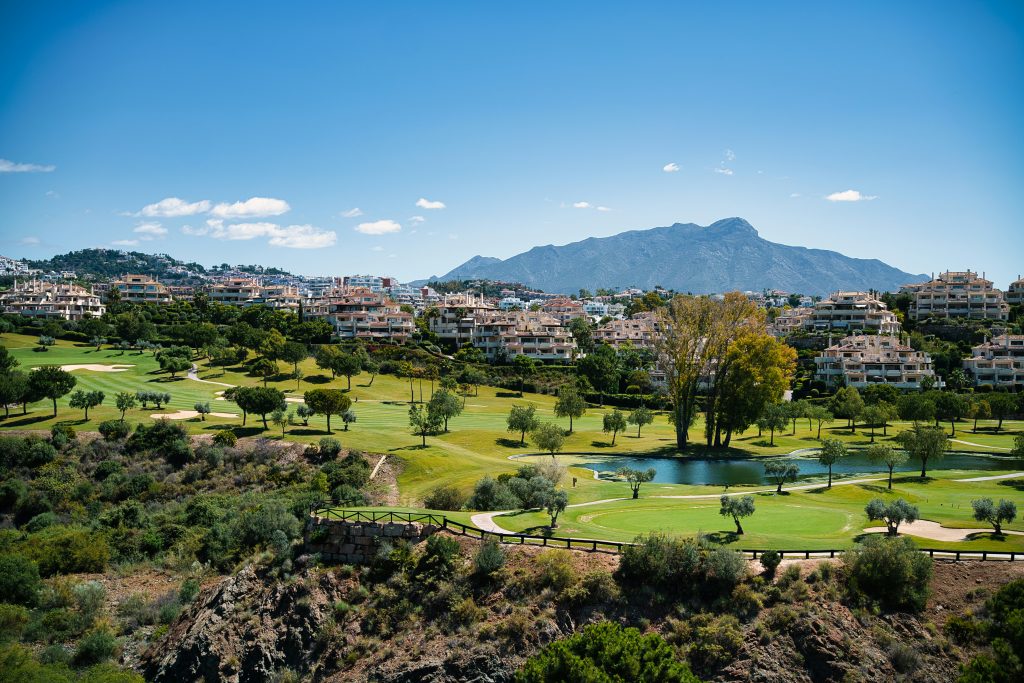
- Costa del Sol’s coastal greens framed by Mediterranean blue and the Sierra Blanca.
These environments create what psychologists call “visual completeness.” The eye rests faster. The nervous system downshifts sooner.
Guests report the same phenomenon repeatedly: the holiday feels longer than it was. This is visual luxury at work—not ornamentation, but spatial intelligence. For discerning travelers, it’s the difference between sightseeing and immersion. For destination planners, it’s a reminder that aesthetics are functional assets, not decoration.
4. The Clean-Fuel Itinerary: Performance Beyond the Scorecard
Preparation isn’t only about swings—it’s about absorption. Wellness-oriented resorts in Cadiz, Huelva, and similar Spanish destinations understand this deeply.
Think in stages:
- Rinse out: Gentle arrival days in the Costa de la Luz that purge travel stress.
- Toast: Heat, massage, and mobility work in specialized Spanish thalassotherapy centers to awaken tissue.
- Absorb: Slow rounds, Mediterranean cuisine (much like the disciplined preparation of a perfect rice dish), and cultural pacing.
This mirrors clean-performance nutrition: remove contaminants, apply controlled stress, and then allow integration. Golfers who travel through Spain this way don’t chase volume; they chase coherence. From a service standpoint, this approach reflects maturity—designing itineraries that respect recovery, not just activity.
In essence, climate arbitrage in golf isn’t about gaming prices—it’s about understanding systems. Weather, biology, landscape, and logistics all carry hidden signals for those trained to read them. When Spanish trips are designed with that level of fluency, value becomes durable, experiences deepen, and performance—on and off the course—stops being accidental. This is how modern golf travel evolves: quietly, intelligently, and with respect for the variables that actually matter.